quarta-feira, 22 de dezembro de 2021

STEAM & MakerSpace Education - Berlin, Germany

4th day - 9th December, 2021

Waking up with snow...


Design Thinking - is an iterative process that provides a solution-based approach to solving problems. Using a structured framework, students identify challenges, gather information generate potential solutions, refine ideas, and test solutions.


How does it work?

More than a question you have a initial situation that requires students to find a solution. It's connected to real life.

It comes down to 5 essential concepts:


To summarize:

Design thinking helps students to:

1. develop an innovator's mindset (alternative solutions, try them)

2. connect what they learn in class to real world challenges (practical problems)

3. foster a disposition of problem-solving

4. collaborate and work with others

5. build emphathy by thinking about the needs of other people, of others as the "end users" of their creative solutions

6. feel empowered to make meaningful changes to the world around them

7. foster the kind of creativity and solutions-driven thinking required in 21 st century workplaces.


We have all the essential elements for the STEAM project! 
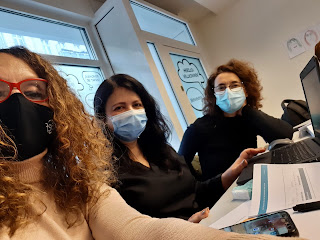

                                            The end of the work day...


quarta-feira, 8 de dezembro de 2021

STEAM & MakerSpace Education - Berlin, Germany


3rd day - 8th December, 2021


                                                          in the classroom


MAKERSPACES IN EDUCATION

What is a Makerspace?

It is a collaborative work space inside a school, library or separate public/private facility for making, learning, exploring and sharing that uses high tech to no tech tools.

Maker Movement

"The Maker Movement encourages a growth mindset, which tolerates risk and failure and maybe even encourages it." (Laura Fleming) 

So, to fail is completely ok.

"When you teach a child something, you take away forever his chance of discovering it himself." (Jean Piaget)

Thus, a similar theory to the STEAM plan in which students discover by themselves.

In the Maker Movement the teacher is a fundamental figure to coach students, to guide them; the teacher is a reference for them. Besides mentoring, openness, another feature of the Maker Movement, is not about the final product but the learning process. It is learning by doing! 

Making should also be playful as play builds social-emotional competence in many domains: 

- language skills, 

- social skills, 

- empathy, 

- imagination (to apply the knowledge they acquire in the process), 

- self-control, 

- persistence (assess the engagement of the students not to give up trying to find the solution), and

- higher-order thinking (the use of critical thinking).

Who is a Maker?

Everyone is a Maker. It is important to foster this mindset.

The Maker Manifesto


How do we learn?


To get warm during our break... some hot chocolate!

terça-feira, 7 de dezembro de 2021

STEAM & MakerSpace Education - Berlin, Germany

Second day: 7th December 2021

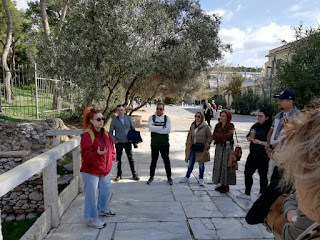
In the morning, during the Europass Berlin Tour...

In front of the Parliament

   Our guide, Federico  "For the German people"

The Berlin wall
(on the left side is the East and on the right is the West)

 Memorial to the Sinti and Roma of Europe murderer
under National Socialism

Brandenburg Gate

The Holocaust Memorial

segunda-feira, 6 de dezembro de 2021

STEAM & MakerSpace Education - Berlin, Germany


First day: 6th December 2021

STEAM Education:

Why should we apply this methodology?

The 21st century skills refers to a broad set of knowledge, skills, work habits and character traits that are believed to be critically important to success in today`s world, particularly in school programs and contemporary careers and workplaces.

Through our study we can solve problems in real world


Francesco Molinari


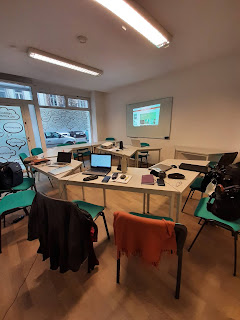
Our classroom
Our classroom

sábado, 20 de novembro de 2021


Designing Inclusive Learning Environments (ILE) to

Support all Students (DILEs)


6.º dia de formação - 19-11-2021


O último dia de formação ficou destinado a várias atividades culturais. De modo a podermos visitar alguns dos monumentos mais importantes da cidade, fomos amavelmente agraciados com bilhetes que permitiram o acesso aos mesmos, devidamente acompanhados por um guia turístico local.


Após concluírem formalmente este curso, com a duração de 30 horas, os participantes que o completaram, com sucesso, receberam o respetivo Certificado entregue pelo Teacher Trainer - Dimitris Zisimopoulos.


sexta-feira, 19 de novembro de 2021


Designing Inclusive Learning Environments (ILE) to

Support all Students (DILEs)


5.º dia de formação - 19-11-2021


De modo a dar continuidade aos assuntos abordados no dia anterior, a sessão de hoje iniciou com uma abordagem à temática "Curriculum Modification", seguida de um trabalho de pares, o qual deu origem a uma interessante discussão.


No seguimento do diálogo, visualizamos vários vídeos sobre os ambientes de aprendizagem. A título de exemplo, apresentamos o seguinte link relativo a um dos referidos vídeos:  

https://www.youtube.com/watch?v=M2vMKqC_fD8

Posteriormente, foi-nos apresentado o modelo "Three-tier instructional model", que consiste numa forma de diferenciação que permite que cada aluno se destaque no seu próprio nível de complexidade. Este modelo possibilita atender a diferentes estilos de aprendizagem, necessidades, níveis e inteligências.


Posto isto, passou-se à elaboração de um plano de aula baseado no Desenho Universal para a Aprendizagem.

O dia culminou num agradável convívio entre todos os participantes.


quinta-feira, 18 de novembro de 2021


Designing Inclusive Learning Environments (ILE) to

Support all Students (DILEs)


4.º dia de formação - 18-11-2021 


Ao longo deste dia, no seguimento da sessão anterior, demos continuidade à abordagem do modelo "Desenho Universal para a Aprendizagem" (DUA). Nesta linha, focamos a nossa atenção nos princípios fundamentais, a saber, envolvimento, representação e ação & expressão.


A implementação de práticas, tendo por base o DUA, implica uma abordagem flexível e personalizada por parte dos docentes na forma como envolvem e motivam os alunos nas situações de aprendizagem.
Assim, é imprescindível conhecer e compreender as diferenças que existem entre os alunos. Neste âmbito, após um profícuo trabalho de grupo, foram elencadas as estratégias e os instrumentos para aferir conhecimentos, interesses, expectativas, fragilidades e potencialidades.


Nesta linha, preenchemos um questionário, a fim de identificar a forma como cada um dos presentes aprende (estilo visual, auditivo e tátil), no sentido de sensibilizar os presentes para a necessidade de atender aos diferentes estilos de aprendizagem com que nos deparamos, em contexto de sala de aula.


Por fim, todos os formandos foram contemplados com uma visita ao grandioso Museu da Acrópole, a qual foi bastante enriquecedora.