quinta-feira, 14 de abril de 2022

Finnish Education System - Helsínquia, Finlândia - Dia 5

Dia 5 - 14.abril.2022

Embora não nos tenhamos afastado muito de Helsínquia, visitamos hoje outra escola fora da cidade. Estivemos na Kaitaan Koulu Comprehensive School, uma escola com cerca de 300 alunos com idades correspondentes ao nosso 3.º Ciclo e com alunos de necessidades educativas especiais com dificuldades de aprendizagem e comportamentais. Fomos recebidos pela Diretora, Ritva Mickelsson, que se encontrava com uma cadela ao colo o que despertou imediatamente a curiosidade de todos. Foi tão evidente que a Diretora explicou logo que não era o único animal na escola, que possuíam autorização para que pudessem circular livremente e que funcionavam como terapia para alguns alunos.

quarta-feira, 13 de abril de 2022

Finnish Education System - Helsínquia, Finlândia - Dia 4

 Dia 4 - 13.abril.2022

Voltamos a Leppavaara. Esperava-nos o Diretor "Principal" da Viherlaakso Primary School, Mikko Leppänen, que nos recebeu na "Mediateca" da sua escola. Nesta escola estão cerca de 330 alunos com idades correspondentes aos nossos 1.º e 2.º ciclos. Depois de nos fazer uma breve apresentação do funcionamento da escola, acompanhou-nos pelos vários espaços de forma a sentirmos a sua atmosfera. Percecionamos algumas diferenças relativamente à escola visitada no dia anterior: o espaço exterior onde os alunos brincam livremente qualquer que seja o estado do tempo (vestindo a roupa e o calçado que tiraram quando entraram na escola), as atividades orientadas que realizam nos espaços comuns (costura, carpintaria, pintura,...). Não conseguimos não comentar o facto de os alunos, nestas idades, fazerem o seu próprio prato e verificarmos que tanto passava um prato bem cheio como um prato com meia dúzia de ervilhas e de grãos de arroz! Mais uma evidência da responsabilização e autonomia dos alunos. Nas salas de aulas foi possível visualizar a liberdade na forma de estar dos alunos: no sofá, na cadeira, num banco de baloiço, de costas para o quadro,... Surpreendidas ficamos com a Mediateca, a quantidade de tecnologia diferente e de vanguarda ao serviço dos alunos. Um espaço interativo com uma sala de projeção 360º, um grande tapete interativo, um ecrã 3D com simulações para Biologia, Física, Química,... Um espaço muito confortável com sofás, cadeiras e almofadas onde está criado um ambiente calmo, cativante e propício para a aprendizagem.

terça-feira, 12 de abril de 2022

Finnish Education System - Helsínquia, Finlândia - Dia 3

Dia 3 - 12.abril.2022

No dia de hoje saímos de Helsínquia para nos dirigirmos a Leppavaara (cerca de 20 km para Norte). O objetivo da manhã era a visita a uma Upper Secondary School - Leppavaran Lukio. Fomos recebidos pelo Diretor "Principal", Ismo-Olav Kjaldman, que nos fez uma apresentação da escola e nos acompanhou numa visita à mesma de forma a podermos percecionar o dia a dia de uma escola finlandesa. Tivemos a oportunidade de contactar com alunos e professores e assistir a aulas das mais variadas disciplinas. 
No final, reunidos na mesma sala, o Diretor esteve disponível para responder às várias questões que surgiram. Antes de terminarmos a passagem pela escola, almoçamos na cantina da mesma.  

segunda-feira, 11 de abril de 2022

Finnish Education System - Helsínquia, Finlândia - Dia 2

 Dia 2 - 11.abril.2022

Hoje conhecemos um dos nossos formadores - Arne Verhaegen - consultor educacional, formador na EduFuture e professor de História. A primeira parte da sessão incidiu sobre alguns aspetos da cultura finlandesa, nomeadamente fatores que constituem a sua alta performance: o melhor governo do mundo, o baixo índice de corrupção, a igualdade de género,  a educação básica e a saúde,  a educação superior e a formação e a presença constante nos dez melhores do PISA desde 2003.
O que permitiu alcançar esse grau de excelência foi o facto de a Finlândia não ter muitos recursos, o que os levou a investir nas pessoas. 

Finnish Education System - Helsínquia, Finlândia - Dia 1

Dia 1 - 10 de abril de 2022

Programa cultural - tour por Helsínquia com uma “happy guide”

Fomos acompanhados pela simpática, teatral e conhecedora Maria, uma guia feliz que nos fez a legenda das fotografias dos principais monumentos e locais de Helsínquia e nos ensinou a história da origem da Finlândia. Levamos a inteligência, a persistência e a determinação na construção da identidade e independência dos Finlandeses.

quarta-feira, 22 de dezembro de 2021

STEAM & MakerSpace Education - Berlin, Germany

 6th  day - 11th December, 2021


Tour in Potsdam


Our last day was a tour in Potsdam


Our tour guide, Federico, showing us the map of Potsdam


Our group


Potsdam is the capital of the German state of Brandenburg.

It directly borders the German capital, Berlin, and is part of the Berlin/Brandenburg Metropolitan Region. Potsdam was a residence of the Prussian kings and the German Kaiser until 1918. The city is over 1000 years old and is known for its palaces, lakes, and it overall historical and cultural significance. Worth mentioning: the parks and palaces of Sanssouci, (Germany's largest World Heritage Site),as well as other palaces, such as: the Orangery Palace, the New Palace the Cecilienhof Palace, or the Charlottenhof Palace.


                               Sanssouci Park


Frederick II (1712-1786) was Prussia’s king from 1772 until his death. He was the last Hohenzollern monarch titled King in Prussia and declared himself King of Prussia after annexing Polish Prussia from the Polish–Lithuanian Commonwealth in 1772.


His most significant accomplishments include his military successes in the Silesian wars, his re-organisation of the Prussian Army, the First Partition of Poland, and his patronage of the arts and the Enlightenment.

Prussia greatly increased its territories and became a major military power in Europe under his rule. He became known as Frederick, the Great. Frederick was a supporter of enlightened absolutism, stating that the ruler should be the first servant of the state.


                           Sanssouci palace                                        

"Whoever improves the soil, cultivates land lying waste and drains swamps,is making conquests from barbarism". Frederick II

Frederick was keenly interested in land use, especially draining swamps and opening new farmland for colonists who would increase the kingdom's food supply. Frederick understood this project as the "taming" and "conquering" of nature, considering uncultivated land "useless", an attitude that reflected the enlightenment era way of thinking. He presided over the construction of canals for bringing crops to market, and introduced new crops, especially the potato and the turnip, to the country. For this, he was sometimes called Der Kartoffelkönig (the Potato King).


        Frederick’s grave (with potatoes)


   Tschüss, Berlin!


STEAM & MakerSpace Education - Berlin, Germany

5th day - 10th December, 2021

Our last day of sessions: work oral presentation


Our work


Our certificates: mission accomplished!


STEAM & MakerSpace Education - Berlin, Germany

4th day - 9th December, 2021

Waking up with snow...


Design Thinking - is an iterative process that provides a solution-based approach to solving problems. Using a structured framework, students identify challenges, gather information generate potential solutions, refine ideas, and test solutions.


How does it work?

More than a question you have a initial situation that requires students to find a solution. It's connected to real life.

It comes down to 5 essential concepts:


To summarize:

Design thinking helps students to:

1. develop an innovator's mindset (alternative solutions, try them)

2. connect what they learn in class to real world challenges (practical problems)

3. foster a disposition of problem-solving

4. collaborate and work with others

5. build emphathy by thinking about the needs of other people, of others as the "end users" of their creative solutions

6. feel empowered to make meaningful changes to the world around them

7. foster the kind of creativity and solutions-driven thinking required in 21 st century workplaces.


We have all the essential elements for the STEAM project! 


                                            The end of the work day...


quarta-feira, 8 de dezembro de 2021

STEAM & MakerSpace Education - Berlin, Germany


3rd day - 8th December, 2021


                                                          in the classroom


MAKERSPACES IN EDUCATION

What is a Makerspace?

It is a collaborative work space inside a school, library or separate public/private facility for making, learning, exploring and sharing that uses high tech to no tech tools.

Maker Movement

"The Maker Movement encourages a growth mindset, which tolerates risk and failure and maybe even encourages it." (Laura Fleming) 

So, to fail is completely ok.

"When you teach a child something, you take away forever his chance of discovering it himself." (Jean Piaget)

Thus, a similar theory to the STEAM plan in which students discover by themselves.

In the Maker Movement the teacher is a fundamental figure to coach students, to guide them; the teacher is a reference for them. Besides mentoring, openness, another feature of the Maker Movement, is not about the final product but the learning process. It is learning by doing! 

Making should also be playful as play builds social-emotional competence in many domains: 

- language skills, 

- social skills, 

- empathy, 

- imagination (to apply the knowledge they acquire in the process), 

- self-control, 

- persistence (assess the engagement of the students not to give up trying to find the solution), and

- higher-order thinking (the use of critical thinking).

Who is a Maker?

Everyone is a Maker. It is important to foster this mindset.

The Maker Manifesto


How do we learn?


To get warm during our break... some hot chocolate!

terça-feira, 7 de dezembro de 2021

STEAM & MakerSpace Education - Berlin, Germany

Second day: 7th December 2021

In the morning, during the Europass Berlin Tour...

In front of the Parliament

   Our guide, Federico  "For the German people"

The Berlin wall
(on the left side is the East and on the right is the West)

 Memorial to the Sinti and Roma of Europe murderer
under National Socialism

Brandenburg Gate

The Holocaust Memorial

segunda-feira, 6 de dezembro de 2021

STEAM & MakerSpace Education - Berlin, Germany


First day: 6th December 2021

STEAM Education:

Why should we apply this methodology?

The 21st century skills refers to a broad set of knowledge, skills, work habits and character traits that are believed to be critically important to success in today`s world, particularly in school programs and contemporary careers and workplaces.

Through our study we can solve problems in real world


Francesco Molinari


Our classroom
Our classroom

sábado, 20 de novembro de 2021


Designing Inclusive Learning Environments (ILE) to

Support all Students (DILEs)


6.º dia de formação - 19-11-2021


O último dia de formação ficou destinado a várias atividades culturais. De modo a podermos visitar alguns dos monumentos mais importantes da cidade, fomos amavelmente agraciados com bilhetes que permitiram o acesso aos mesmos, devidamente acompanhados por um guia turístico local.
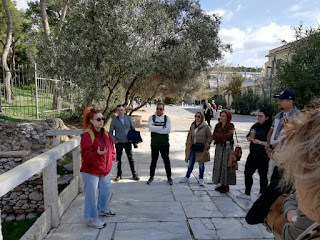


Após concluírem formalmente este curso, com a duração de 30 horas, os participantes que o completaram, com sucesso, receberam o respetivo Certificado entregue pelo Teacher Trainer - Dimitris Zisimopoulos.


sexta-feira, 19 de novembro de 2021


Designing Inclusive Learning Environments (ILE) to

Support all Students (DILEs)


5.º dia de formação - 19-11-2021


De modo a dar continuidade aos assuntos abordados no dia anterior, a sessão de hoje iniciou com uma abordagem à temática "Curriculum Modification", seguida de um trabalho de pares, o qual deu origem a uma interessante discussão.


No seguimento do diálogo, visualizamos vários vídeos sobre os ambientes de aprendizagem. A título de exemplo, apresentamos o seguinte link relativo a um dos referidos vídeos:  

https://www.youtube.com/watch?v=M2vMKqC_fD8

Posteriormente, foi-nos apresentado o modelo "Three-tier instructional model", que consiste numa forma de diferenciação que permite que cada aluno se destaque no seu próprio nível de complexidade. Este modelo possibilita atender a diferentes estilos de aprendizagem, necessidades, níveis e inteligências.


Posto isto, passou-se à elaboração de um plano de aula baseado no Desenho Universal para a Aprendizagem.

O dia culminou num agradável convívio entre todos os participantes.